

Die Quelle und meine Verbindung zu China
Pi / Anmut – Erleuchten durch Präsenz
☷ ☲Hexagramm 22 – Pi / Anmut (Der Berg unter dem Feuer – die Form, die das Wesen offenbart)
Das Hexagramm Pi / Anmut aus dem I Ging erleuchtet den Fuß des Berges, wie die untergehende Sonne, die nicht verbrennt, sondern sichtbar macht. Es lädt uns ein, einen besonderen Moment im Leben zu erkennen: jenen, in dem die Form mehr Macht hat als die Substanz, in dem das, was an der Oberfläche erscheint, zu einer Brücke zur Authentizität werden kann.
Das Feuer in diesem Hexagramm verzehrt nicht. Es hebt hervor. Ebenso ist jetzt die Zeit, in der das Bild, das wir ausstrahlen, mehr Wirkung haben kann als unser tiefstes Wesen. Doch das ist keine Täuschung: Es ist eine Chance. Die Möglichkeit, Wahrheit durch Schönheit, Harmonie und bewusste Präsenz zu vermitteln.
🌱 Der Weise und die Weise versuchen nicht, die Welt auf einen Schlag zu verändern. Sie handeln achtsam in den kleinen Dingen des Alltags – im Wissen, dass jede Geste Bedeutung hat.Das I Ging sagt:„Erfolg im Kleinen. Dies ist ein guter Moment, um zu beginnen.“
Jetzt ist der richtige Zeitpunkt, neue Projekte zu starten, lange gehegte Ideen umzusetzen, aufrichtige Verbindungen zu schaffen – selbst in Umfeldern, die auf den ersten Blick nur an Äußerlichkeiten interessiert scheinen. Gerade heute kann die äußere Form ein Tor sein, das sich öffnet. Das Funkeln zieht an – und kann zum Kanal für eine echte Botschaft werden.
Manchmal fühlen wir uns gesehen, aber nicht wirklich verstanden. Doch gesehen zu werden, ist bereits ein Anfang. Gehört zu werden, ist bereits Präsenz. In diesem Raum der Sichtbarkeit können wir etwas Echtes hineintragen. Auch wenn nur wenige die Tiefe erkennen – diese wenigen können zu wertvollen Verbündeten werden.
✨ Es ist nicht die Zeit, sich zu widersetzen. Es ist die Zeit, anzunehmen.Anmut bedeutet nicht Maske, sondern die Kunst der Präsenz.Durch äußere Schönheit können wir Aufmerksamkeit wecken – und in dieser Aufmerksamkeit unsere innere Wahrheit zum Klingen bringen.
Diese Botschaft möchte ich heute all jenen widmen, die mit Mut und Hingabe die eleganteste und kraftvollste aller körperlichen Künste leben: das Ballett.
🩰 Ellie, die diese Wege mit offenem Herzen und tiefem Blick begleitet, kennt den Wert des Details, der Geste, des Rhythmus, der von innen kommt und sich außen widerspiegelt. Sie weiß, wie man die Verwandlung empfängt, die geschieht, wenn man lernt, Anmut zu tragen – innen wie außen.
💫 Schritt für Schritt. Wort für Wort. Von Hand zu Hand.So entsteht Schönheit. So wird Anmut in die Welt getragen.
🇬🇧 Pi / Grace – Illuminating Through Presence
☷ ☲Hexagram 22 – Pi / Grace (The mountain beneath the fire – form revealing essence)
The hexagram Pi / Grace from the I Ching lights up the mountain’s base, like the setting sun that doesn’t burn, but reveals. It invites us to recognize a special moment in life: the moment when form holds more power than substance, when what appears on the surface can become a bridge to authenticity.
In this hexagram, the fire does not consume. It enhances. In the same way, today is a time when the image we project may have more impact than our deepest essence. But this is not deception: it is an opportunity. A chance to convey truth through beauty, harmony, and presence.
🌱 The Sage does not force the world to change all at once. Instead, they act with awareness in the small, everyday things – knowing every gesture has value.The I Ching says:“Success in small things. This is a good time to begin.”
Now is the right time to start new projects, to bring long-held ideas to life, to form sincere connections – even in environments that may seem focused only on appearances. More than ever, form can be a door that opens. Sparkle attracts, but it can become the channel for an authentic message.
Perhaps we sometimes feel seen, but not truly understood. And yet, being seen is already a beginning. Being heard is already presence. In this space of visibility, we can choose to bring something real. Even if only a few perceive its depth, those few may become precious allies.
✨ This is not the time to resist. This is the time to receive.Grace does not mean wearing a mask, but practicing the art of presence.Through outer beauty, we can inspire attention – and within that attention, let our inner truth resonate.
This is the message I want to share today with all those who, with courage and dedication, step into the world through the most elegant and powerful of bodily arts: ballet.
🩰 Ellie, who walks these paths with an open heart and a deep gaze, knows the value of detail, of gesture, of rhythm born within and reflected without. She welcomes the transformation that comes from training to embody grace – inside and out.
💫 One step at a time. One word at a time. From hand to hand.This is how beauty is created. This is how grace moves into the world.
🇮🇹 Pi / Grazia – Illuminare con la presenza
☷ ☲Esagramma 22 – Pi / Grazia(La montagna sotto il fuoco – la forma che rivela l’essenza)
L’esagramma Pi / Grazia dell’I Ching illumina la base della montagna, come il sole al tramonto che non brucia, ma rivela. È un invito a riconoscere un momento speciale della vita: quello in cui la forma ha più potere della sostanza, in cui ciò che appare in superficie può diventare un ponte verso l’autenticità.
Il fuoco, in questo esagramma, non consuma. Esalta. Allo stesso modo, oggi è il tempo in cui l’immagine che proiettiamo può avere un impatto più forte della nostra essenza più profonda. Ma questo non è un inganno: è un'opportunità. È la possibilità di trasmettere verità attraverso bellezza, armonia, presenza.
🌱 Il Saggio e la Saggia non forzano il cambiamento del mondo tutto in una volta. Scelgono invece di agire con consapevolezza nelle piccole cose quotidiane, sapendo che ogni gesto ha valore.L’I Ching dice:“Successo nelle piccole cose. Questo è un buon momento per cominciare.”
È il momento giusto per avviare nuovi progetti, per portare a termine idee rimaste in attesa, per creare connessioni sincere, anche in ambienti che a prima vista sembrano solo interessati all’apparenza. Oggi più che mai, la forma può essere una porta che si apre. Lo scintillio attrae, ma può diventare canale per un messaggio autentico.
Forse a volte ci sentiamo visti, ma non davvero compresə. Eppure essere visti è già un inizio. Essere ascoltatə è già una presenza. In questo spazio di visibilità, possiamo scegliere di portare qualcosa di vero. Anche se saranno in pochi a coglierne la profondità, quei pochi potranno diventare alleatə preziosə.
✨ Non è il momento di resistere. È il momento di accogliere.Grazia non significa maschera, ma arte della presenza. Attraverso la bellezza esteriore possiamo ispirare attenzione, e in quell’attenzione, far risuonare la nostra verità interiore.
Questo è il messaggio che oggi voglio condividere con tuttə coloro che, con coraggio e dedizione, si mettono in gioco attraverso la più elegante e potente delle arti corporee: il balletto.
🩰 Ellie, che accompagna questi percorsi con cuore aperto e sguardo profondo, conosce il valore del dettaglio, del gesto, del ritmo che nasce da dentro e si riflette fuori. Sa accogliere la trasformazione che avviene quando ci si allena a portare grazia, dentro e fuori il corpo.
💫 Un passo alla volta. Una parola alla volta. Di mano in mano.Così si costruisce bellezza. Così si porta grazia nel mondo.
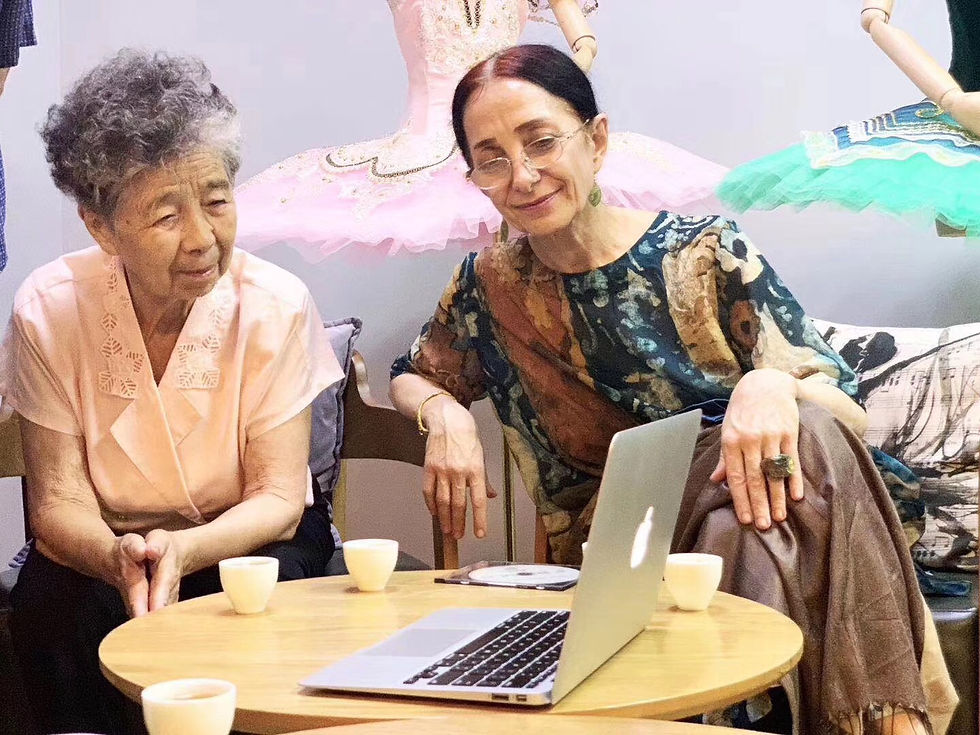
📸 Jang Zu Hui und Alessandra Grasso
蒋祖慧 Jiang Zuhui: Anmut auf den Zehenspitzen
Quelle: Guangming Daily – 10. April 2019Autorin: Meng Meng (Außerordentliche Professorin, Tanzakademie – Shandong University of Arts)
Jiang Zuhui, Tochter der bekannten Schriftstellerin Ding Ling, war eine der Hauptchoreografinnen des weltberühmten Balletts Das Rote Frauenbataillon – ein Meilenstein in der chinesischen Tanzgeschichte, der klassisches Ballett mit chinesischer Tradition und revolutionärem Ausdruck vereint.
Ursprünglich wollte Jiang Naturwissenschaften studieren, doch ihre Mutter überzeugte sie, sich dem Ballett zu widmen – als Kunstform für das neue China. Mit 15 begann sie ihre Ausbildung in Korea, setzte sie in Peking fort und spezialisierte sich in der Sowjetunion auf Choreografie.
1964, im Alter von 30 Jahren, war sie Mitverantwortliche für die Bühnenadaption des Films Das Rote Frauenbataillon. Inspiriert durch eine Reise nach Hainan, entwarf sie Choreografien, die die Stärke der Heldin Qionghua durch Elemente chinesischer Tanzkunst und Peking-Oper zeigten.
Das Ballett wurde ein großer Erfolg. Die kubanische Primaballerina Alicia Alonso sagte nach der Aufführung:
"Zum ersten Mal in der Geschichte des Balletts tanzen Kämpferinnen auf Spitze – großartig"
Jiang schuf viele weitere Werke und wurde 1984 stellvertretende Direktorin des Chinesischen Nationalballetts. Auch im Ruhestand blieb sie kreativ – vom klassischen Ballett bis zum Volkstanz.
2014 erhielt sie den “Lotus Lifetime Achievement Award”, die höchste Auszeichnung der chinesischen Tanzwelt.
Ihr Credo:
"Innovation ohne Wurzeln ist schwach. Wir müssen von den Klassikern lernen, bevor wir Neues schaffen. Man kann nicht mit einem Sprung in den Himmel gelangen.“
Am Ende des Interviews stand Jiang auf – und tanzte. Ihre Bewegungen strahlten noch immer eine natürliche, lichtvolle Eleganz aus.
🇬🇧蒋祖慧 Jiang Zuhui: Elegance on Pointe
Source: Guangming Daily – April 10, 2019Author: Meng Meng (Associate Professor, Dance Academy – Shandong University of Arts)
Jiang Zuhui, daughter of renowned writer Ding Ling, is one of the choreographers of the iconic ballet The Red Detachment of Women, a milestone in Chinese ballet that blends classical technique with traditional Chinese movement and revolutionary spirit.
Originally interested in science, Jiang was encouraged by her mother to pursue ballet as an essential future art form for China. At 15, she began studying dance in Korea, later continuing in Beijing and the Soviet Union with a focus on choreography.
In 1964, at the age of 30, she co-created the ballet adaptation of The Red Detachment of Women. Inspired by field research in Hainan, she designed choreography that portrayed the heroine Qionghua’s resilience by integrating Chinese classical dance and Peking Opera elements into ballet.
The ballet gained national and international acclaim. After seeing it, Cuban ballerina Alicia Alonso said:“For the first time in ballet history, dancers on pointe with rifles. Remarkable!”
Jiang went on to create many other major works and became Deputy Director of the National Ballet of China in 1984. Even after retirement, she continued to explore new forms—from ballet to folk dance.
In 2014, she received the Lifetime Achievement "Lotus Award", China’s highest honor in dance.
She reflects:
“Innovation without roots is fragile. We must stand on the shoulders of giants before moving forward. You can’t leap to the sky in a single step.”
At the end of the interview, Jiang stood up and danced. In every gesture, her natural grace still lit up the room.
🇮🇹 蒋祖慧: L’eleganza sulle punte
Fonte: Guangming Daily – 10 aprile 2019Autrice: Meng Meng (Prof.ssa associata, Accademia di Danza – Shandong University of Arts)
Jiang Zuhui, figlia della scrittrice Ding Ling, è co-autrice del celebre balletto Il distaccamento femminile rosso, pietra miliare della danza cinese, capace di fondere il linguaggio del balletto classico con la forza espressiva delle danze tradizionali e della scena rivoluzionaria.
Inizialmente orientata verso gli studi scientifici, Jiang fu incoraggiata dalla madre a dedicarsi alla danza, per rispondere a un futuro artistico della nuova Cina. A 15 anni cominciò così un percorso che la portò in Corea, a Pechino e in URSS, dove si specializzò in coreografia.
Nel 1964, a soli 30 anni, firmò con altri due colleghi la regia coreografica del Distaccamento, ispirandosi a un viaggio sull’isola di Hainan e fondendo movimenti di balletto, danza cinese e opera di Pechino per rappresentare la protagonista Qionghua, figura simbolo di coraggio e resistenza.
Il balletto riscosse enorme successo in patria e all’estero. Alicia Alonso, dopo averlo visto, esclamò:
“Per la prima volta nella storia del balletto, danzatori sulle punte armati di fucili. Straordinario!”
Negli anni successivi Jiang creò molte altre opere importanti e nel 1984 divenne vice direttrice del Balletto Centrale della Cina. Anche dopo il pensionamento ha continuato a coreografare, esplorando nuovi linguaggi, dal balletto alla danza popolare.
Nel 2014 ha ricevuto il Premio “Fiore di Loto” alla carriera, il massimo riconoscimento per la danza in Cina.
Dice Jiang:
“L’innovazione senza radici è fragile. Bisogna assorbire l’eredità dei grandi, poi trovare la propria strada. Non si può saltare in cielo in un solo balzo.”
Alla fine dell’intervista, si è alzata sorridendo e ha danzato. Nei suoi gesti, ancora oggi, brilla una grazia naturale che illumina lo spazio attorno.


Commenti